*****
Tragedy happens “..while someone else is eating or opening a window or just walking dully along...” W H Auden tells us, in his 1938 poem: Musee Des Beaux Arts. Thus Icarus falls fatally from the skies, but for the ploughman who may have heard the splash, it was no major event. And while Princess Diana was fatally hurtling through Paris subways with Dodi Al Fayed, Amélie begins her quest to do good for others.
Amélie is celebrating 25 years since its first showing. It’s a pleasing, amusing, quirky film that sometimes borders on the absurd and the surreal, and often delights by illustrating the ordinariness of the unusual. Social outcasts and misfits abound, but director Jean-Pierre Jeunet references their relatable idiosyncracies.
The story has similarities to Jane Austen’s Emma. Amélie, like Austen's heroine, takes delight in arranging other people’s love matches, but ends up trying to fix her own. Unlike the artful and interfering Emma Woodhouse who glories in her own success rather than in other people’s happiness, Amélie Poulain is genuinely altruistic. A social outcast herself, having been wrongly diagnosed as a child by her medic father, she was educated at home by her mother, causing her to be socially isolated and psychologically timid and withdrawn. The film skips through Amélie’s early life, thanks to a matter of fact narrator and accompanying deadpan treatment of mishap and tragedy alike. The death of Amélie’s mother is as unlikely as it is tragic, but glossed over at flashback pace. Thus tragedy becomes comedy.
Amélie communicates with her associates via postcard, letter and public phone boxes. Aah, those days. When selfies were done in passport-photo cubicles, and the social media-less world was a more naïve, more cheerful experience.
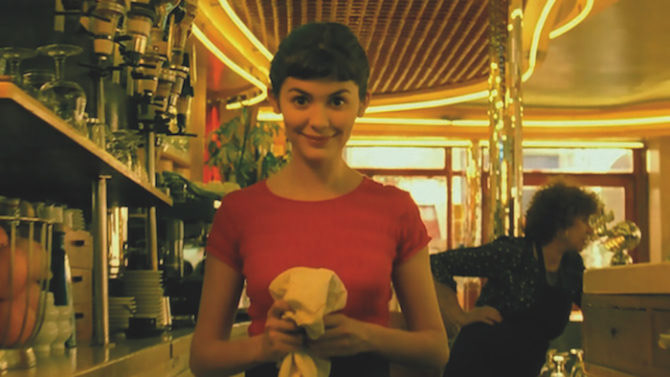
Our wide-eyed, heroine communicates with her filmic audience in that postmodern knowing, flirtatious glance that beams out from this classic film’s posters. Audrey Tatou has much of Audrey Hepburn about her. She looks stylish without much effort. She charms gently.
Several of the scenes are rich with wit. The object of Amélie’s love divides his working days between a sex shop and a fairground ghost train. He shares his anxieties with the sex shop manager as she passes him giant dildoes to staple the packaging and nonchalantly put them onto the display shelf. One of Amelie’s brief matchmaking successes sees a cigarette seller in the café and a paranoiac punter crazed by jealousy share a sexual encounter in the café toilet that is accompanied by close up shots of cocktail glasses and sundry bar-room utensils vibrating to the point of orgiastic cacophony. Slick editing, great scriptwriting, intricate and colour-rich sets along with a troupe of actors blessed with a keen sense of comic timing make this a film of chuckles and smiles.
The story zips along, seemingly with no end in sight, until a very clever twist reminds us that the unlikely conspiracy theory conclusions to life’s mysteries are often flattened by plain old ordinary explanations. Thus it is with the photo-booth plot – another staple of 20th century life that has fallen into disuse.