Emerald Cuts desparkle Brontё gem
*****
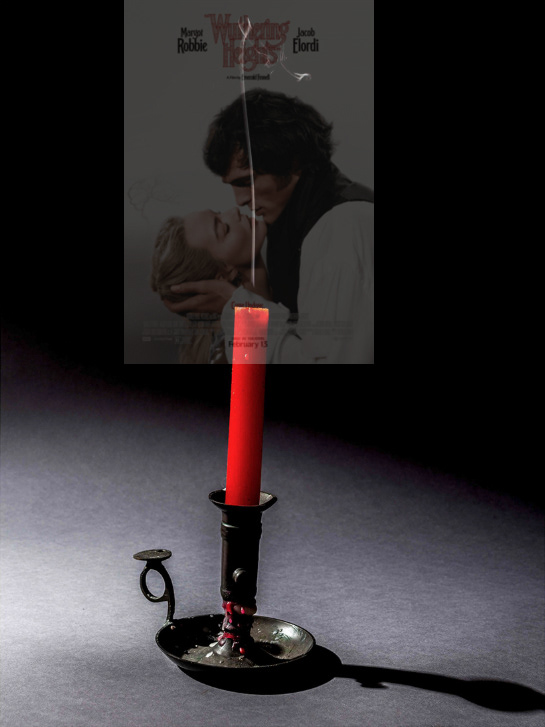
The 2026 film based on Wuthering Heights, starring Margot Robbie and directed by Emerald Fennell, focuses on the relationship between Heathcliff and Catherine Earnshaw, to the exclusion of several key characters, and events, in the novel.
The film concludes with the end of their mortal relationship, viz: the death of Catherine. This recent film reflects contemporary obsessions and uses sexual activity as a synonym for passion. Brontё might wince at some of Fennell's lurid references. They smack of the clickbait TicToc age with its images of transient and shallow sexual gratification. Late 18th century it is not; Wuthering Heights... well, it is, in part, but it omits so much of Brontё’s version that the word 'unambitious' hangs over the film like a grey sky over the moors.
The film is a tragic love story. So too is the novel, but after Catherine's death Brontё's story develops into a revenge tragedy. Heathcliff determines that the next generation will suffice as proxy victims for his deranged grief. All of the post-Catherine revenge saga is omitted from the Fennell film.
The revenge genre peaked in the late 16th and early 17th century with British dramatists ( Shakespeare's Titus Andronicus is a classic example, along with The Spanish Tragedy, The Jew of Malta, 'Tis Pity She's a Whore, et al). It is an unpleasant, often deeply uncomfortable genre. Bloodthirsty, sadistic characters outdo each other in hideous plots to wreak their own vengeance. The essence of the revenge tragedy is to examine the concept of justice, and how a wronged person might inflict his own punishment as payment for grievance. Philosopher Francis Bacon, in 1625, proclaimed: "Revenge is a kind of wild justice". Shakespeare's bloodthirsty Titus Andronicus, immured to brutality by war and a succession of personal grievances, kills his own son early in the play, and later kills his daughter who has already been raped, had her tongue cut out and her hands cut off by two villainous characters. In John Ford's 1629 play 'Tis Pity She's a Whore, a brother having got his sister pregnant, stabs her to death, skewers her heart on a dagger, and parades it before a banquet.
Wuthering Heights has no such gore. It has plenty of talk of death, but these mortal conclusions stem from illness and genetic physical weaknesses. Towards the end of the novel, Heathcliff goes to Catherine's grave, opens the lid of her coffin and gazes at her face. She has been dead for 18 years, and Heathcliff remarks: "I saw her face again- it is hers yet."
Heathcliff is a cruel and sadistic master, father, father-in-law and uncle, and he deliberately tortures his relatives, psychologically and physically. He wounds and draws blood from men, women and children. But he does not kill them. He plots to humiliate them, to pay them back for the wrongs that have caused him to be separated from the love of his life. He clearly hopes that the humiliation will be fatal, to his victims and to himself. He takes pleasure in the deaths of his wife, her brother, his master, his master's son... and himself.
The shifting narrative perspective is one of the touches of genius in this work. The traveller Lockwood introduces us to the story. Nelly Dean then takes over. Heathcliff, Isabella, young Catherine and Zilla all narrate episodes, giving the reader a multi-camera view of the action. However unlikely the cruelty, there is no shortage of witnesses.
The narrative space (the diegesis) of the novel is confined, bordering on incestuous. The characters live in two homes: Thrushcross Grange and Wuthering Heights. Visits from outsiders, such as the doctor Kenneth, are rare, and fleeting. Key relationships involve cousins from two sides of the families. Heathcliff himself is virtually an adopted child of Catherine's father, and in the early days, like a brother to his future lover. The intensity of this cauldron of relationships is heightened by Heathcliff's notion, and Catherine's, that mortal existence neither defines nor constrains love. Beyond boyhood and adolescence, Heathcliff is happy at only one point in the novel, towards the end, when, it is implied, he is nearing the long-dead Catherine and is better able to commune with her. He actually smiles in Nelly's presence, and this smile cannot be shifted from his deathbed face. Nor can his eyes be closed. Catherine believed that her love for Heathcliff would endure like the rocks. Heathcliff was godless, but he believed in an afterlife, in the eternity of love, his love for Catherine and hers for him. This is an uncomfortable message in a novel published in mid-19th century Britain when religious doubts were growing but religious forces maintained a powerful grip on cultural norms. The opening chapters of the story involve a ghostly visitation that preface the conclusion. Brontё's father was the local parson, but the philosophy of Wuthering Heights goes beyond Victorian religion. There is a supernatural element to the story; not one that feeds on a gothic sense of scary fantasy, but one that hints at an understanding of life and death on a more cosmic plane.
The 2026 film successfully explores and conveys the issues of status, mannered society and wealth that Emily Brontё navigates, particularly in the first half of the story. But the novel is far more ambitious and intellectually challenging than Fennell's film.
We are still yet to see a successful adaptation of this masterpiece.