*****
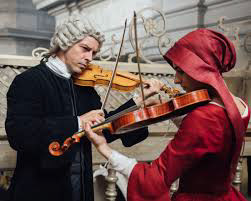
Adolescent girls discover a cat with several newly born, still blind kittens in the cloisters of their Venetian orphanage. The sweetness of the moment is disrupted by the charmless prioress, who bags the kittens and throws them abruptly down a well. This blunt statement about the nature of motherhood sets the tone of the film. The orphan girls, trained in music, await the time when they will be ‘bought’ by a future husband of any age, most likely very senior. The girls have no choice. Their lives are frugal, their musical talents, once they leave the orphanage, are irrelevant. The brutality of patriarchy in 18th century Venice and the indiscriminate victimisation of girls, particularly poor girls, is laid bare. They perform concerts unseen behind a grilled balcony, they wear masks in public, their red uniforms and bonnets hint at Margaret Atwood’s Handmaid’s Tale dystopia.
The story, based on Venice's Ospedale della Pieta, has vague echoes of Peter Mullan's uncompromising and unremittingly dark film of 2002, 'The Magdalene Sisters'. The human rights of the girls, in both films, are inconsequential. Servitude, strict discipline and spartan lifestyles at the Ospedale are followed by forced marriage. Such barbarity is surely a distant past of civilised nations. Not so. UK governments, paralysed by the fear of offending the practices of any culture, regardless of human rights issues, finally managed to outlaw forced marriage in 2014.
In Primavera, the gifted, intractable Cecilia (Tecla Insolio) is singled out by the new music tutor, maestro Vivaldi, (Michele Riondino) for her virtuosic talent. Cecilia longs to know more about her mother, and spends evenings secretly writing to her. It is a futile hope; the mother, probably a prostitute in a city abundant with itinerant sailors, never appears. Cecilia’s destiny, it seems, is to be married to decorated war hero Sanfermo, as soon as he returns from the Venetian-Turkish conflict at the siege of Corfu.
One of the less naïve inmates describes to the girls how the orphans are inspected by a surgeon before marriage to ensure their virginity is intact. Virginity is their only currency. Without it, they are worthless. She warns them of the discomfort of the wedding night, and beyond. Marriage is a bleak prospect, even compared to their orphanage existence. At least, in the orphanage, they can escape into the vast dominion of Vivaldi's creative musical brilliance.
The polarity created by wealth and gender is stark. The orphans are commodities. The rich are vacuous, self-important men, driven by greed, or, in the case of the wives, bored.
Much of the film focuses on Vivaldi’s music, his inspiration, and his vision for his eventual Four Seasons masterpiece. Cecilia is his muse, though never, despite rumours, his romantic attachment. The beauty of the music, and the treatment of musical composition and orchestral direction, accompanied by some stunning scenes of Venetian architecture, make the film a joy. So too do some interior scenes, with open window and dark shadow creating Vermeer-like tableaux, crystalising the anguish of Cecilia, and latterly, her increasingly sympathetic prioress.
Cecilia, to the surprise of everyone, including the audience, has devised a strategy for escaping a hateful marriage. But after she is victim to a brutal attack by her thwarted husband-to-be, her options seem stifled. Meanwhile, Vivaldi is rehearsing with great passion his opera Juditha Triumphans, in honour of the Corfu heroes. He explains to his soloist that the heroine Judith, while seeming to love Holofernes, has hatred enough in her to decapitate him with a concealed knife.
Is this the ending for Cecilia to follow? As brutally as the film began, with the kittenicides?
No, nothing so melodramatic. Cecilia’s escape is by contrast, bloodless and gentle, on a gondola, as she smiles, bonnetless and happy, hair flowing, surrounded by a class of Venetians that we see in the final scene for the first time, the adult poor.